Automating Magento code review with GitHub Actions
A reusable, open-source engine: deterministic checks, PHP static analysis, and a Claude AI reviewer
On this page
Reviewing Magento pull requests by hand, across a dozen client repositories, is a lot of the same work over and over:
is the PR titled with the Jira key, are the new modules registered, does the diff trip PHPCS, is there a var_dump
someone forgot. It is important work, but most of it is mechanical — and mechanical work is what CI is for. So I built a
reusable GitHub Actions code review engine and open-sourced it:
github.com/zynqa/code-review-engine
.
The pipeline
Every pull request runs through a single reusable workflow. Each stage is optional and toggled per repository, and the final merge gate only judges the checks you actually enabled.
One reusable workflow, six optional stages. The gate only requires what you switched on.
One workflow, every repository
The engine is a single reusable workflow. A consumer repo doesn’t copy CI logic around — it calls the engine and picks which checks to run:
# .github/workflows/code-review.yml
name: Code Review
on:
  pull_request:
    types: [opened, edited, synchronize, reopened]

jobs:
  review:
    uses: zynqa/code-review-engine/.github/workflows/review.yml@main
    with:
      magento-version: "2.4.5-p5"
      jira-project-key: "PROJ"
      enable-pr-validation: true
      enable-module-registration: true
      enable-static-analysis: true
      enable-ai-review: false
      enable-tests: false
    secrets: inherit
Because everyone points at @main, fixing a rule or adding a check in the engine rolls out to every repository on its
next PR — no bumping versions across a dozen projects.
Point every repo at @main once; each keeps its own profile of enabled checks.
Deterministic first, AI second
The order matters. Cheap, deterministic checks run first and catch the mechanical problems for free, so the AI review (the only stage that costs money and time) is spent on judgement, not on things a linter already knows.
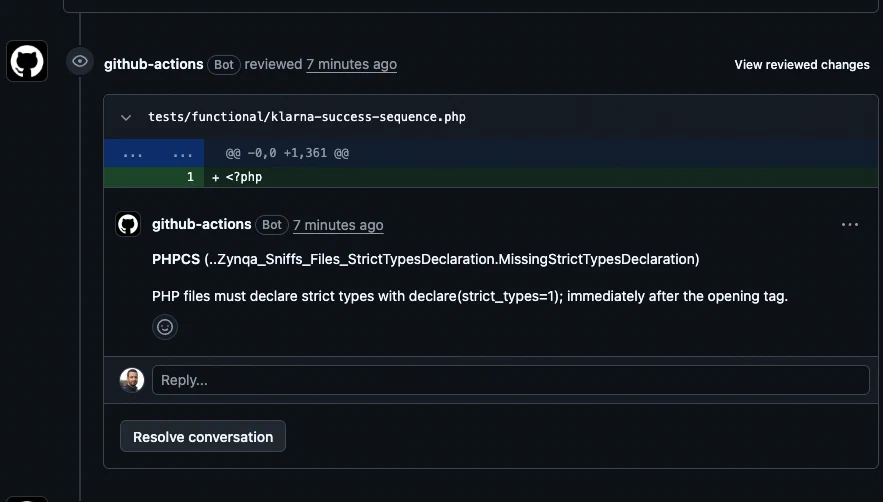
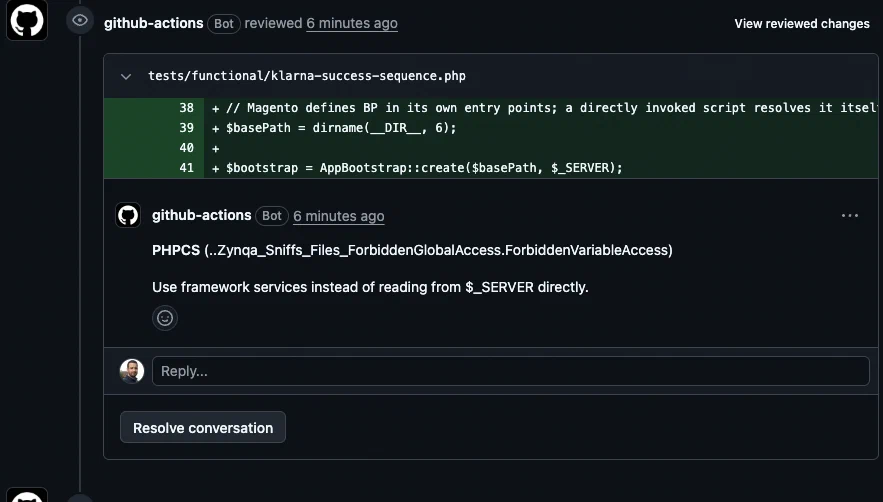
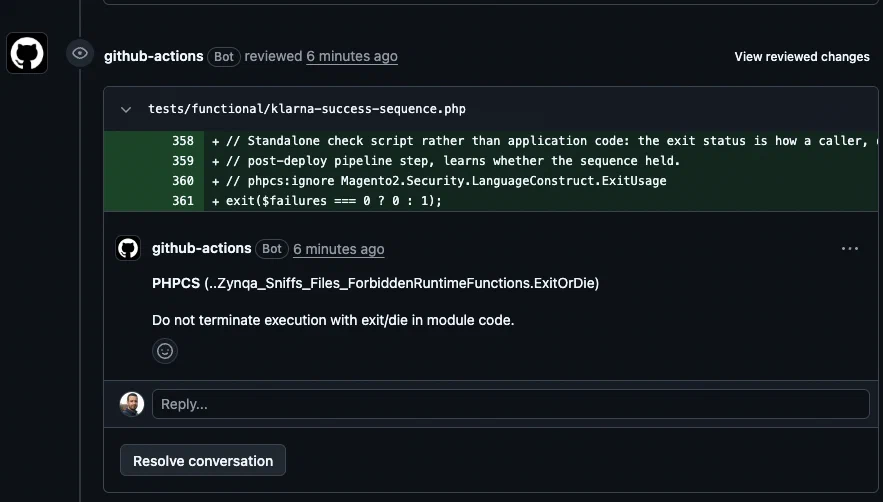
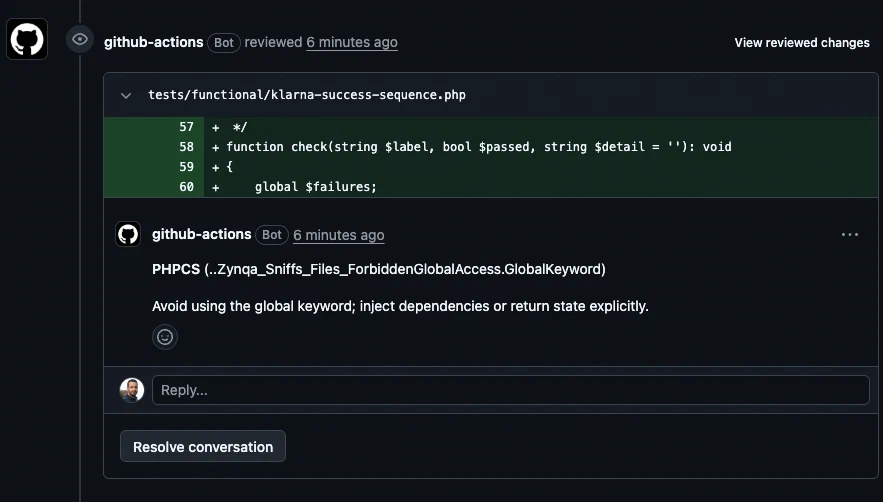
Static analysis runs only on the files the PR changed, not the whole repository — fast, and the comments land on the lines you actually touched. It runs PHPCS, PHPStan and PHPMD, and posts GitHub annotations, inline review comments, and a sticky summary with counts per tool. On top of the standard Magento sniffs, the engine ships custom Zynqa PHPCS rules:
declare(strict_types=1);is required- Magento helpers must be stateless
- no superglobals and no
global - no
eval,die,var_dump,print_r,error_log - no direct
ObjectManagerusage - no deprecated
Setup/InstallSchema.php - admin controller inheritance /
ADMIN_RESOURCErules - no inline presentation logic in
.phtml
Here are a few of those rules firing as inline review comments on a real pull request — click any to expand:
The AI reviewer, with real context
Only once the mechanical checks pass does the Claude reviewer run — and it doesn’t just see the diff. It pulls the surrounding context a human reviewer would open in other tabs: the Jira ticket, related Confluence pages, and Slack threads, alongside the GitHub PR itself. That is the difference between “this method is long” and “this doesn’t do what the ticket asked”.
The reviewer reads the ticket, the docs and the chat — not just the diff — then comments on the exact lines.
If AI review is enabled without an ANTHROPIC_API_KEY, the job fails loudly rather than silently skipping — a check you
think is running should actually run.
The merge gate
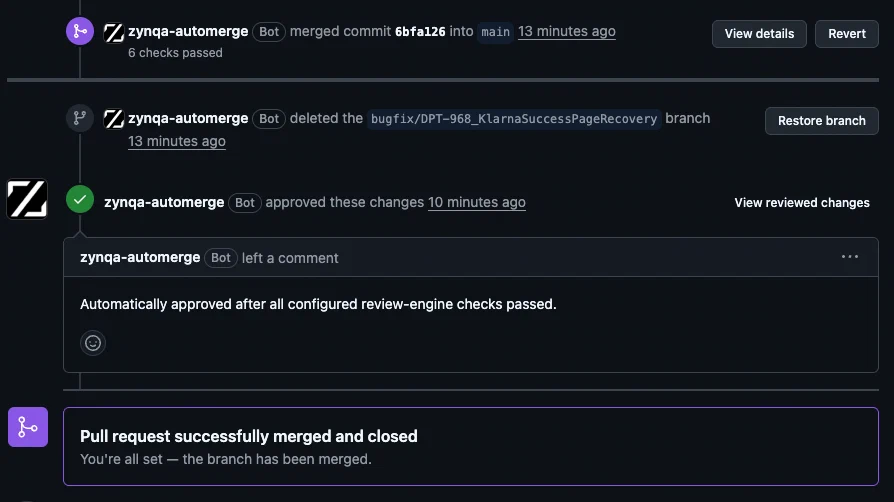
When the enabled checks pass, the last stage can approve the PR as github-actions[bot], pick an allowed merge method,
update the branch if it is behind, and merge — falling back to GitHub’s native auto-merge when a ruleset blocks a direct
merge. Crucially, the gate only evaluates the checks a repo turned on, so a module repo running just static analysis
isn’t held hostage to an AI review it never enabled.
Profiles
Two toggle profiles cover most repos. A Magento application repo tends to run PR conventions + module registration +
static analysis + auto-approval; a standalone module repo usually runs just static analysis (and maybe tests). Both
are a handful of true/false inputs — no forked pipelines.
Try it
It’s open source: github.com/zynqa/code-review-engine
. Copy the
project template
into a repo’s
.github/workflows/, set the inputs, keep secrets: inherit, and your next pull request gets the full treatment. Start
with static analysis only — it’s the highest signal for zero configuration — and switch on the rest as you trust it.